Calibration Data Review: Check Changes Before They Count
A calibration data review brings the second opinion where it counts: to the individual parameter. VersaCal joins change, check and release into one flow. The commit happens only after sign-off.
Why a Calibration Data Review Has to Outgrow Files
Many teams still pass calibration states around as files. A question then lands in an email, a comment in a spreadsheet. The link between a value and its reasoning gets lost quickly.
Moreover, proving later who checked what becomes nearly impossible. A calibration data review therefore deserves the same standing as code review in software development. It belongs on the dataset, not beside it.
The Flow From Draft to Released State
Changes start in a draft. The series state stays untouched although you are already working. From there you then open a change request.
- First: create a draft and change parameters
- Second: open a change request — VersaCal builds comparison and health report
- Third: read the risk scoring and the AI summary of the change
- Fourth: settle comments per parameter
- Finally: sign-off by a second role, then commit with a certificate
What the Reviewer Actually Sees
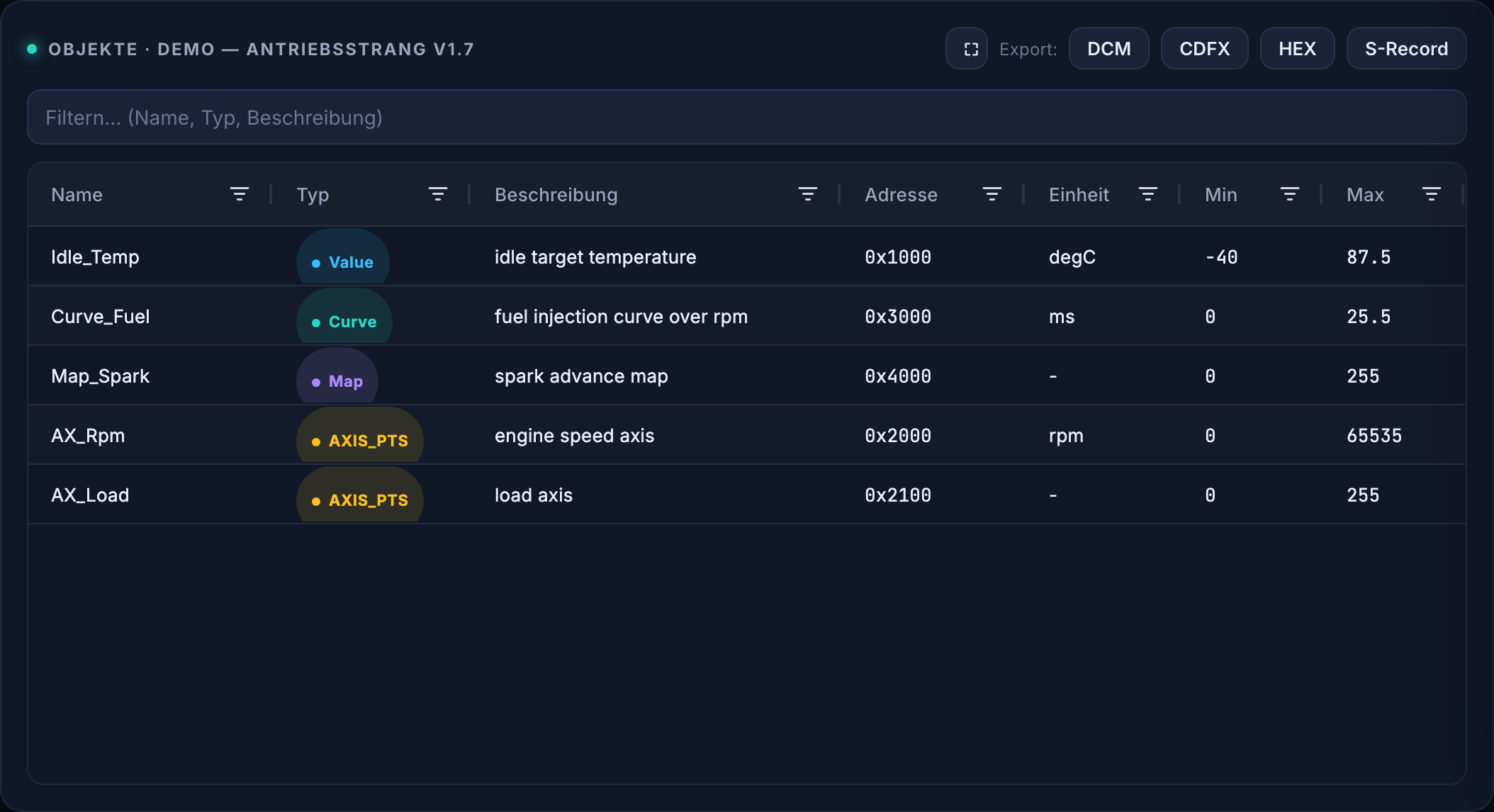
A diff over bytes does not help in review. VersaCal therefore shows every changed parameter with physical old value, new value, unit and delta. From any row you jump into the A2L source or onto the HEX address.
The health report adds limits, monotonicity and gradients. The AI assistance summarises the change and scores its risk. It writes nothing itself, however: every suggestion passes preview and sign-off.
Four-Eyes Principle, Technically Enforced
An agreement in a process manual can be bypassed. A gate in the tool cannot. VersaCal therefore separates the roles strictly into viewer, calibrator and approver.
Whoever made the change does not sign it off. Only the second role's approval creates the state. A release certificate then exists, and every action sits in the audit trail.
Evidence That Still Holds Later
A calibration data review is only complete while it stays provable. The audit trail records who changed, commented and approved what, and when. Thus a state can be reconstructed years afterwards.
The results also flow into your existing forms. Delta DCM, CDFX, HEX and PDF reports appear at the push of a button. So the review fits release records that you have had in place for years.
Read the standards: ASAM CDF
Frequently asked questions about calibration data review
Can one person release a state alone?
No, as long as the four-eyes gate is active. VersaCal separates the calibrator and approver roles. Whoever introduced a change cannot sign it off themselves. The commit happens only with the second role's approval.
How granular can comments in a calibration data review be?
Per parameter. A comment therefore hangs on the row in question rather than on the whole state. Open points consequently stay visible in the review until they are settled.
What does the risk scoring do?
It rates the changed parameters and highlights the delicate ones, for example large jumps or values close to a limit. The scoring replaces no check. It sorts attention within the review.
See a calibration data review on your flow
Describe your roles and release rules to us. In the demo we show the review on a flow that matches your own.